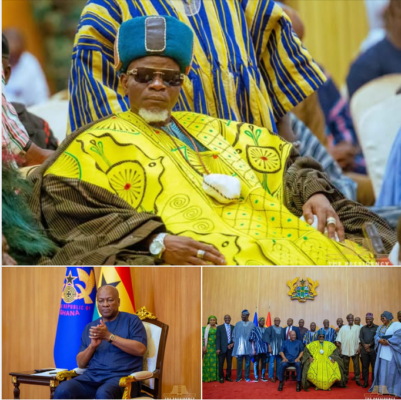
The Regent of Dagbon, Kampakuyanaa Abubakari, has reaffirmed his commitment to promoting peace and unity in Dagbon, pledging to build on the peace initiatives started by his late father while pursuing new efforts to strengthen reconciliation among the people of the traditional area.
Speaking through Naa Bapri Zangbulung Lana, Dr. Jacob Mahama, at the Jubilee House, the Regent stressed that his commitment to peace would transcend traditional and political divisions, with the ultimate goal of safeguarding the unity and stability of Dagbon.
He also reiterated his determination to ensure that the final funeral rites of his late father, the King of Dagbon, Yaa Naa Abubakari Mahama, are performed within 18 months, in accordance with the recently revised Dagbon Constitution.
According to the Regent, the revised constitution, which was put in place by his late father, provides a framework for conducting the final funeral rites and subsequently facilitating the selection of the next substantive ruler of Dagbon in accordance with established cultural practices and well-documented traditional procedures.
He maintained that he would discharge his responsibilities without fear or favour, emphasising his determination to uphold the traditions and customs of Dagbon throughout the process.
Delegation Signals Commitment to Reconciliation
The composition of the delegation that accompanied the Regent to the Jubilee House has attracted attention, with its representation reflecting the various traditional and royal interests within Dagbon.
The delegation reportedly included representatives of both the Abudu and Andani royal gates, alongside Konkonbas, Basares and other traditional leaders from the Dagbon Traditional Council.
The broad representation is seen as an important signal of the Regent’s commitment to reconciliation and his determination to build bridges across traditional divides in the interest of lasting peace.
At a time when unity remains essential to Dagbon’s stability and development, the Regent’s message has renewed attention on the role of traditional leadership in sustaining peaceful relations among the people.
President Mahama Reaffirms Support for Dagbon
President John Dramani Mahama, in his remarks, expressed appreciation for the engagement and reaffirmed his commitment to supporting Dagbon’s peace, security and development.
The President was also thanked for his continued support to Dagbon during the final days of the late king and the events that followed his passing.
President Mahama assured the people of Dagbon that his government would continue to play a neutral role by providing the necessary security, resources and development support to the traditional area.
He emphasised, however, that matters relating to Dagbon’s customs, traditions and traditional leadership remained the responsibility of the recognised traditional authorities.
The President also called on the youth of Dagbon to channel their energies towards maintaining peace and protecting the stability of the area, stressing the importance of collective responsibility in safeguarding the future of the kingdom.
Mahama Faces Historic Opportunity to Consolidate Peace in Dagbon
President Mahama has an important opportunity to help consolidate peace in Dagbon by maintaining a neutral position and supporting a peaceful, constitutionally guided transition in traditional leadership.
The process surrounding the final funeral rites of the late Yaa Naa and the eventual selection of a substantive ruler will require careful handling, broad consultation and strict adherence to the customs and established procedures of Dagbon.
For many who yearn for lasting peace, the current developments present an opportunity to strengthen reconciliation between the Abudu and Andani royal gates and prevent historical divisions from undermining the kingdom’s future.
However, concerns remain that individuals who have historically benefited from divisions within Dagbon could attempt to exploit tensions for their own interests.
The government must therefore exercise caution in considering advice on Dagbon-related matters, ensuring that decisions are guided by neutrality, credible information, respect for traditional authority and the collective interest of the people.
Any attempt to inflame divisions or undermine the peace process must be resisted, regardless of the individuals involved or the interests they represent.
The Need to Protect Dagbon’s Peace
The Regent’s pledge to build bridges and ensure that the final funeral rites of his late father are performed within the stipulated 18-month period places renewed emphasis on the need for cooperation among traditional authorities, political leaders and the people of Dagbon.
Achieving this objective will require patience, mutual respect and a shared commitment to resolving disagreements through established traditional and constitutional mechanisms.
As Dagbon looks towards the next phase of its traditional leadership, the priority must remain the preservation of peace, the protection of its cultural heritage and the promotion of unity among its people.
The responsibility does not rest with the Regent alone. The government, traditional authorities, political actors and the youth all have a role to play in ensuring that Dagbon’s pursuit of peace is not derailed by suspicion, rivalry or personal interests.
Ultimately, the success of the reconciliation process will be measured not merely by the completion of the final funeral rites or the selection of a new ruler, but by the ability of the people of Dagbon to live together in peace, dignity and mutual respect.