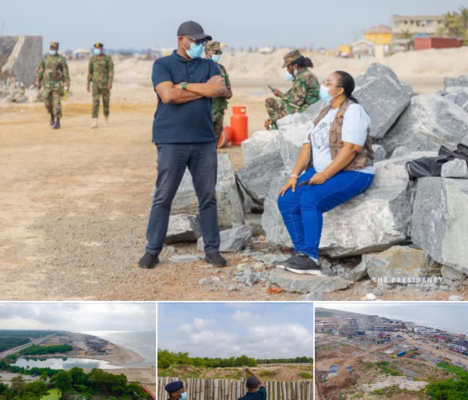
Deputy Chief of Staff in charge of Operations, Stan Xoese Dogbe, has directed the Greater Accra Regional Coordinating Council (GARCC) to begin the ecological restoration of reclaimed sections of the Kpeshie Lagoon following the removal of illegal structures from the wetland’s protected buffer zone.
The directive forms part of ongoing government efforts to restore critical flood-control infrastructure, protect wetlands, and strengthen Accra’s capacity to manage future flooding.
Forestry Commission and EPA to Support Restoration
The restoration exercise will involve the Forestry Commission and the Environmental Protection Authority (EPA), with plans to plant coconut trees and other suitable vegetation across the reclaimed areas.
Authorities are also expected to put in place appropriate environmental safeguards to support the recovery of the fragile wetland ecosystem and prevent renewed degradation.
Directive Issued After Demolition Exercise
Mr Dogbe issued the directive at Laboma following a demolition exercise carried out by the Post Flood Mitigation Task Force.
The exercise forms part of broader measures aimed at removing illegal structures from waterways and flood-prone areas while restoring natural water-retention spaces across the Greater Accra Region.
Focus Shifts From Demolition to Restoration
According to Mr Dogbe, the objective of the exercise goes beyond simply clearing illegal structures from the area.
He emphasized the need to return the reclaimed sections of the Kpeshie Lagoon to as close to their natural state as possible, while improving the lagoon’s ability to retain floodwaters and reducing the risk of future encroachment.
The approach is expected to combine demolition, debris removal, vegetation restoration, environmental monitoring, and long-term protection of the wetland.
Kpeshie Lagoon Critical to Flood Management
The Kpeshie Lagoon is considered an important flood intervention point in Accra. Years of reclamation, sand filling, and development around wetlands have reduced natural water-retention spaces in parts of the capital.
Environmental restoration of the reclaimed sections is therefore expected to help recover some of the lagoon’s ecological and flood-management functions.
Authorities Move to Protect Reclaimed Areas
With the clearance exercise underway, authorities are expected to proceed with the removal of demolition debris and restoration of vegetation.
The involvement of the Forestry Commission and EPA is also expected to strengthen environmental protection measures and ensure that the restored areas are properly managed.
Officials are emphasizing sustained monitoring and enforcement to prevent illegal structures from returning to the protected buffer zone.
Strengthening Accra’s Flood Resilience
The Kpeshie Lagoon restoration forms part of wider efforts to improve flood resilience in Greater Accra by protecting waterways, restoring wetlands, and preventing development in environmentally sensitive areas.
Authorities say maintaining the natural functions of wetlands is essential to reducing flood risks and protecting communities during periods of heavy rainfall.
The restoration initiative is expected to provide both environmental and flood-management benefits while contributing to the long-term protection of Accra’s fragile wetland ecosystems.