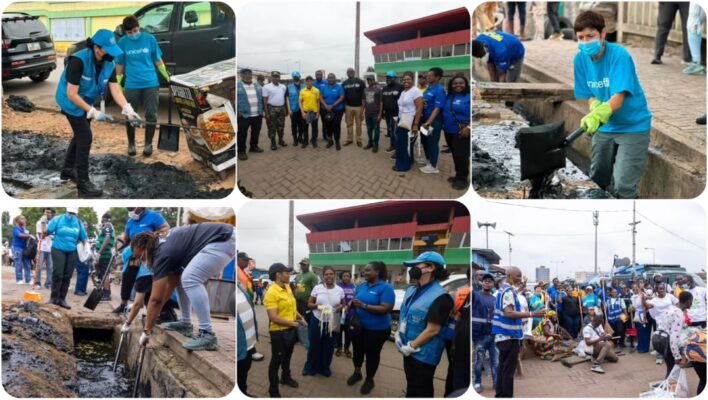
Accra, Ghana – The United Nations (UN) in Ghana has joined the Government of Ghana’s National General Clean-Up Exercise, with staff from several UN agencies participating in the first day of the nationwide campaign aimed at restoring communities affected by the devastating floods of June 29, 2026.
The UN team joined officials of the Korle Klottey Municipal Assembly in Accra to support the government’s initiative, which seeks to improve sanitation, protect public health, and reduce the risk of future flooding.
UN Agencies Participate in Large Numbers
The clean-up exercise was led by the Resident Coordinator ad interim and World Health Organization (WHO) Ghana Resident Representative, Dr. Fiona Braka, who mobilized staff from various UN agencies to take part in the campaign.
Participating agencies included:
- World Health Organization (WHO)
- United Nations Population Fund (UNFPA Ghana)
- International Organization for Migration (IOM Ghana)
- World Food Programme (WFP)
- United Nations Department of Safety and Security (UNDSS)
- UNICEF Ghana
- United Nations Development Programme (UNDP Ghana)
- Office of the UN Resident Coordinator
Together with officials of the Korle Klottey Municipal Assembly, the volunteers desilted choked drains, swept major streets, and cleaned public spaces around Tema Station in Accra.
Zanetor Agyeman-Rawlings Commends UN Support
The exercise was joined by the Member of Parliament for Korle Klottey, Hon. Dr. Zanetor Agyeman-Rawlings, who expressed appreciation to the United Nations for responding to Ghana’s national call to action following the recent floods.
She commended the UN agencies for demonstrating solidarity with affected communities and contributing to efforts aimed at improving sanitation and preventing future disasters.
The Municipal Chief Executive, Hon. Alfred Ato Allotey-Gaisie, and the Municipal Coordinating Director, Mr. Emmanuel Baisie, also welcomed the UN delegation and thanked them for supporting the clean-up campaign.
Dr. Fiona Braka Calls for Collective Responsibility
Speaking to the media during the exercise, Dr. Fiona Braka stressed that environmental protection requires the active participation of every citizen.
“The recent floods were a stark reminder that protecting our environment is a shared responsibility,” she said.
“Each of us has a role to play in keeping our communities clean, safeguarding public health, and reducing the risks of future disasters.”
She emphasized that sustained community action and proper waste management are essential in building resilient cities capable of withstanding climate-related challenges.
Participants Advocate Monthly National Clean-Up Exercise
Several UN staff members who participated in the exercise also shared their views, calling on the Government of Ghana to institutionalize the clean-up campaign by organizing it every month.
According to participants, regular nationwide clean-up exercises would help keep drains free from waste, improve sanitation, reduce flooding, and promote healthier communities.
They noted that making environmental cleanliness a continuous national activity rather than an occasional intervention would significantly strengthen Ghana’s flood prevention efforts.
National Exercise Aims to Build Flood Resilience
The National General Clean-Up Exercise forms part of the government’s broader post-flood recovery strategy following the recent flooding that affected thousands of people across several regions.
Authorities believe that regular community participation, proper sanitation practices, and stronger collaboration between government institutions, development partners, and citizens will help reduce the impact of future floods while protecting lives and property.