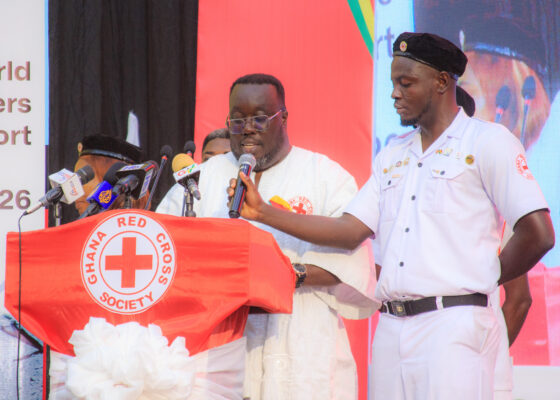
The President of the Ghana Red Cross Society, Edward Donkoh, has called for stronger humanitarian systems, climate resilience and community preparedness as Ghana faces growing public health and environmental challenges.
Speaking during the celebration of World Red Cross and Red Crescent Day 2026 under the theme “United in Humanity,” Mr. Donkoh said the humanitarian landscape in Ghana and across the world has changed significantly, requiring institutions such as the Ghana Red Cross Society to move beyond emergency response toward long-term resilience and recovery.
According to him, humanitarian crises are no longer isolated events but continuous and overlapping pressures driven by climate shocks, disease outbreaks, sanitation challenges and socio-economic vulnerabilities.
“This is not a narrative of failure. It is a signal — a clear urgency signal — that institutions like the Ghana Red Cross Society are no longer optional, but essential,” he stated.
Mr. Donkoh noted that Ghana is increasingly becoming a multi-risk environment due to recurrent flooding, expanding urban vulnerability, sanitation issues and the emergence of epidemic-prone diseases.
He cited concerns over public health indicators, including open defecation, maternal mortality and gaps in healthcare delivery, stressing that these challenges continue to place pressure on vulnerable communities.
Building Resilience Beyond Emergency Response
The Ghana Red Cross Society President explained that the organization’s approach has evolved from reactive humanitarian assistance to anticipatory action, preparedness and long-term recovery support.
He referenced the devastating Akosombo dam spillage and flooding incidents, describing them as a national trauma that displaced thousands of families and destroyed homes and livelihoods.
According to him, the Society provided integrated emergency assistance including shelter, food, relief supplies, psychosocial support and family tracing services to reconnect separated relatives.
Mr. Donkoh also highlighted the Society’s response to recent cholera outbreaks across more than 30 districts in Ghana.
Rather than waiting for the situation to escalate, he said the organization activated preparedness systems early, developed contingency frameworks and strengthened community communication systems to combat misinformation.
“This marks a transition from reactive humanitarianism to anticipatory action — an approach that will define the future of effective humanitarian response,” he emphasized.
Key Humanitarian Projects Across Ghana
The Ghana Red Cross Society is currently implementing several major humanitarian and resilience programmes in partnership with the International Federation of Red Cross and Red Crescent Societies and national stakeholders.
Among the initiatives highlighted was the Local Adaptation Project being implemented in communities in the Central Region between December 2025 and November 2026 with funding support exceeding 100,000 Swiss Francs.
The project focuses on helping communities identify climate priorities and integrate local adaptation strategies into municipal development planning.
In the health sector, the Society is implementing the Resilience and Empowerment African Community Health Project, a two-year €1 million initiative in collaboration with the Ghana Health Service aimed at strengthening community healthcare systems and improving preparedness for public health emergencies.
On disaster preparedness, Mr. Donkoh announced the implementation of a Simplified Early Action Protocol for flooding from January 2026 to December 2027 to support forecast-based early response measures in flood-prone communities.
He also highlighted achievements under the Water, Sanitation and Hygiene (WASH) programme, including the EBA pilot project implemented in Ashanti and Greater Accra regions with support from the Netherlands Red Cross.
According to him, the initiative has already impacted thousands of beneficiaries through improved hygiene promotion and behavioural change communication.
Tribute to Volunteers
Mr. Donkoh paid tribute to over 72,000 volunteers of the Ghana Red Cross Society across the country, describing them as the backbone of the organization’s humanitarian work.
“These are ordinary people who choose every day to do extraordinary things — to respond first, to save lives and to stand in solidarity with vulnerable communities,” he said.
He praised the volunteers for carrying the spirit of humanity with courage, discipline and compassion in difficult and remote environments.
Call for Collective Action
Concluding his address, the Ghana Red Cross Society President called on government institutions, development partners, communities and citizens to invest in humanity, strengthen systems and protect the dignity of vulnerable people.
“The true test of a nation is not how it performs in times of comfort, but how it responds in moments of crisis,” he stated.
He urged Ghanaians to work together toward building a resilient, prepared and compassionate society where no one is left behind during emergencies and disasters.
For more information about the Ghana Red Cross Society, visit Ghana Red Cross Society